The update the owner screenshots and sends to their mum.
Every job ends with a written report built from what you logged on it — route, photos, water, toilet, treats, care. It goes out while you are walking back to the van, and it is better than the message you were going to type.
- Written from the events you actually recorded, and nothing else
- Route map and the photos from that job
- Never a diagnosis, a reassurance or a health judgement
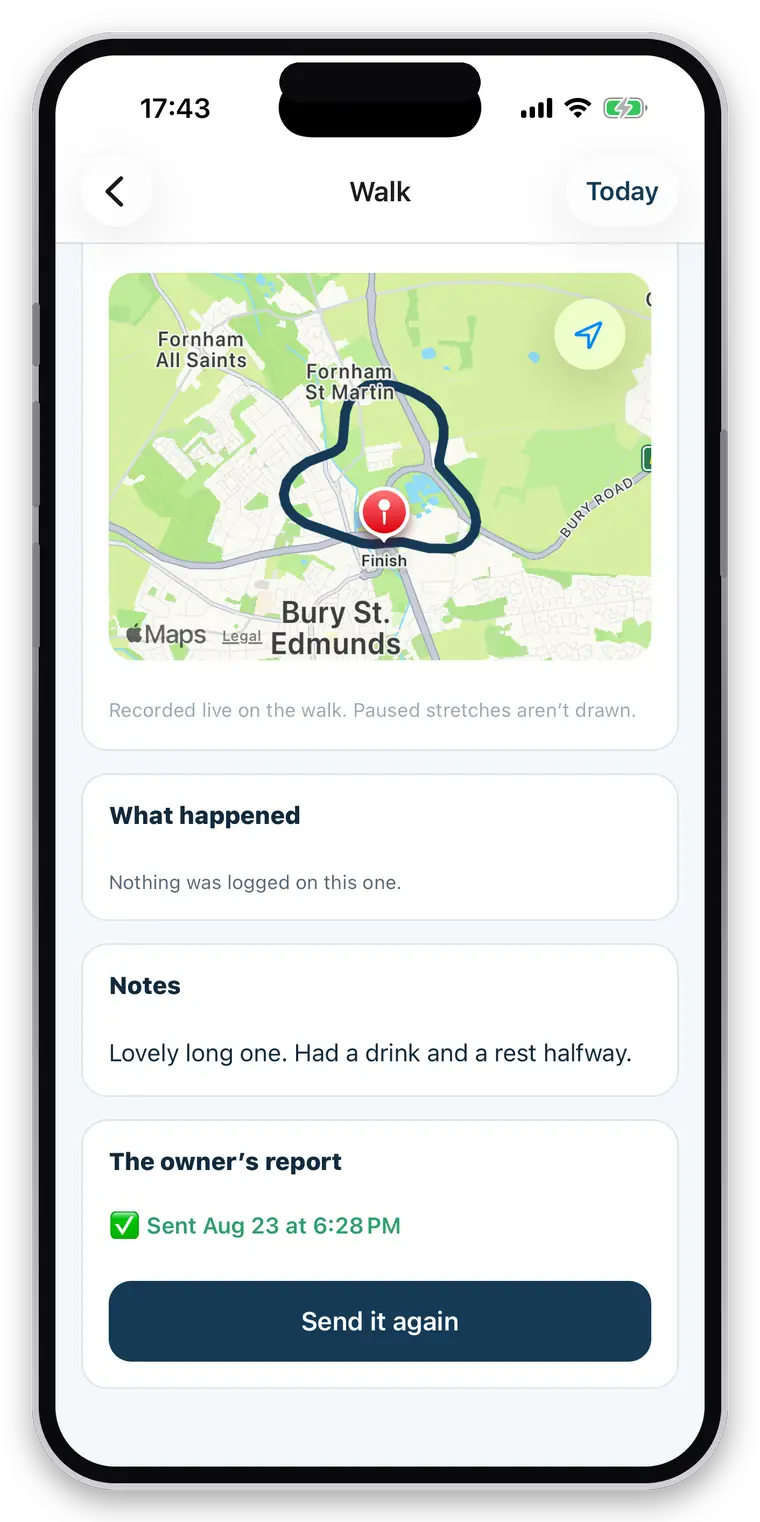
- Delivery status on every report, with a resend button
Full access for 30 days · No card · Unlimited clients and pets
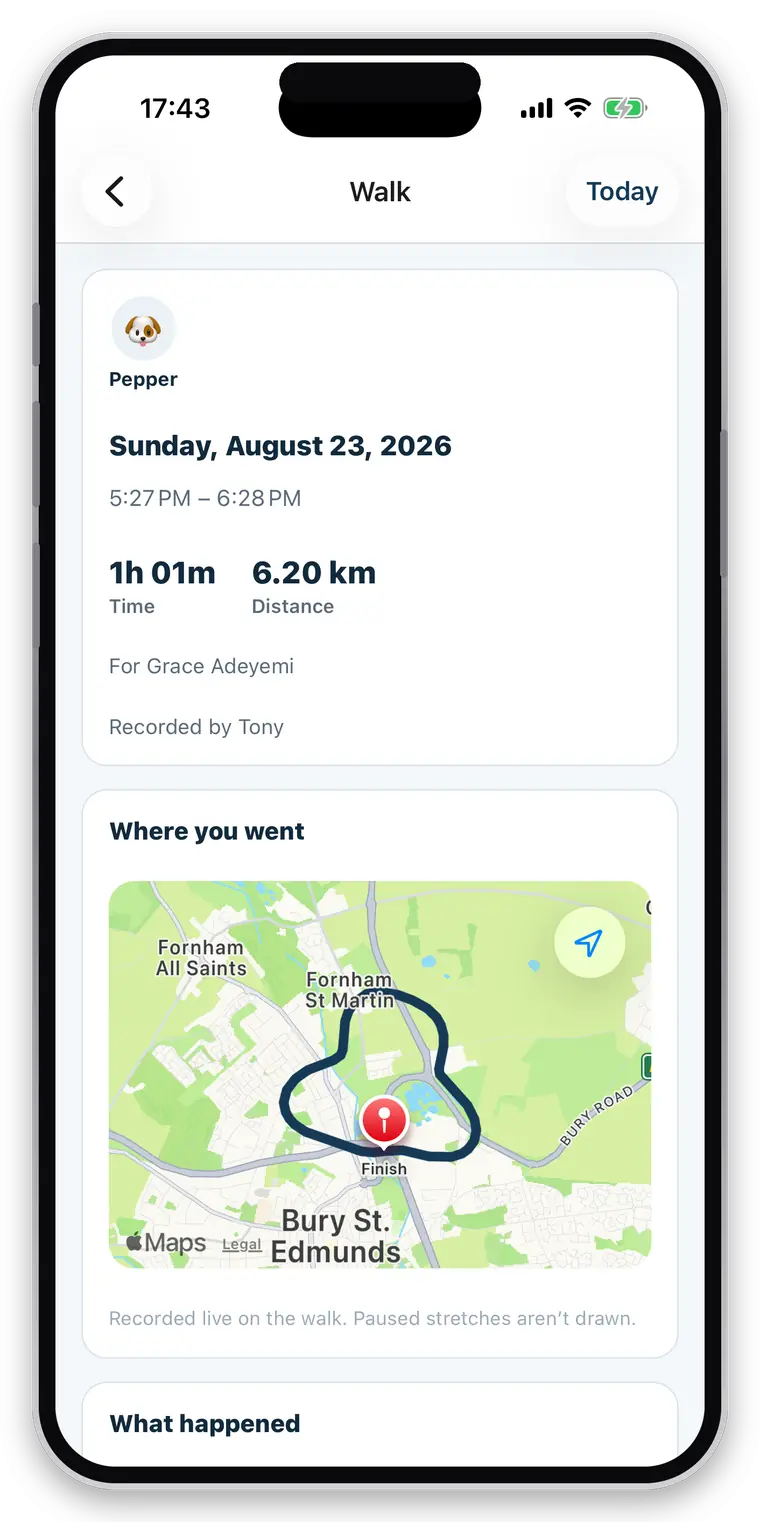
Six clients, six messages, at the end of a nine-hour day.
The end-of-round message is the part of the job that gets shortest as the day gets longer. It is also the part clients value most, and the part they judge you on — a good walker sending “all good today 🐾” six times is being paid for care and reporting like a courier. The report should not compete with your evening for attention.
Typed six times
The same information, retyped per client, from memory, hours after it happened.
Or not sent at all
And an owner who hears nothing wonders. Silence is the thing that loses a client.
And no idea if it landed
A message that failed to send looks exactly like one that arrived, until the client mentions it.
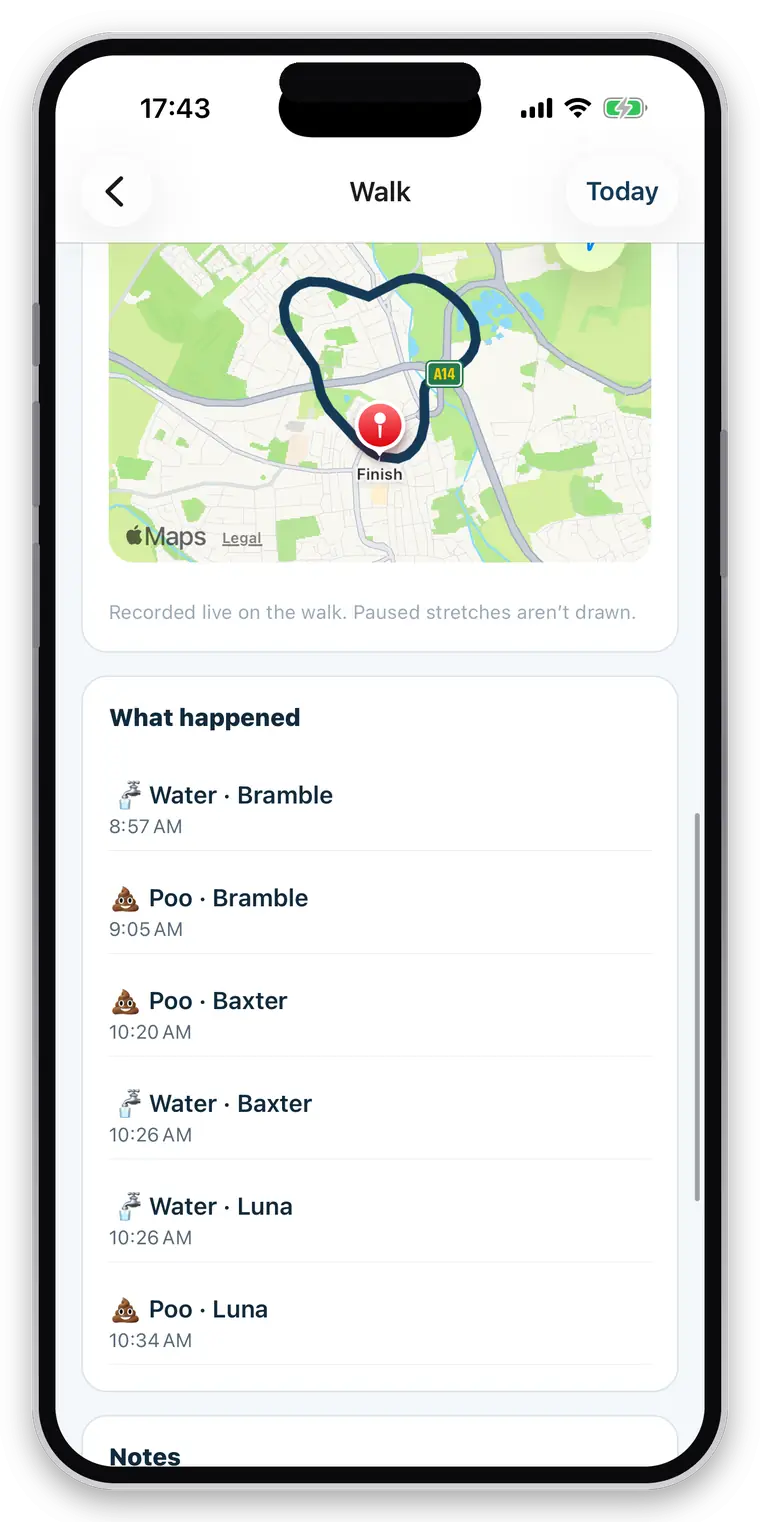
Facts, in sentences, with the pictures.
The report narrates the record: how long the job took, how far you went, what was logged and when — and, on a group walk, that this dog had its own record of the same outing.
- Duration, distance and the route map
- Water breaks, toilets, treats, feeding and medication where logged
- Behaviour notes, injury and sickness where recorded and permitted
- The photos you took, attached to the job they came from
- Who walked the dog — by name, not just your business
It describes. It never decides.
The wording is generated, and it is fenced in hard, because the consequences land on a real animal and on your professional reputation.
- It only asserts what was logged. The model is given counts and timestamps — never a photo, never room to speculate.
- Absences are phrased as absences. “No health concerns were logged during the walk”, never “no signs of limping” — because nobody checked, and the second sentence is the one that gets read back to you if the dog goes lame that afternoon.
- It never makes a health call. No diagnosis, no advice, no reassurance. Where you have logged something worrying, it is stated plainly and the owner decides what it means.
- If the wording engine is unavailable, the report still sends, written plainly from the same facts. A plainer report beats a missing one.
You find out if it failed. Not the client.
This is the part most software leaves out, and it is the part that costs you a relationship. Every report carries its delivery state.
- Sent, failed, or no email address on file — recorded on the walk
- Which addresses it actually reached, for when a client says they never got it
- Failed reports are retried rather than silently dropped
- A resend button, for the times a retry is not what you need
- A report that already arrived is never accidentally sent twice
Straight about what it does not do
There are no video reports, no voice-note transcription and no weekly or monthly digests of a pet’s month yet. The report is generated when the job is finished; there is no editor for rewriting its prose before it goes, though everything it is built from is under your control while you work.
Related
Questions walkers and sitters actually ask
What is included in an owner report?
A written summary generated from the events you actually logged, plus the route map and the photos. Water breaks, toilet, treats, feeding, medication, behaviour, injury and sickness all appear where they were recorded and the owner permitted them. Absences are phrased as absences — "no health concerns were logged" rather than "no signs of illness" — because nobody examined the dog.
Is the report written by AI?
The wording is, from the facts you logged and nothing else. The model is given counts and timestamps, never a photo and never room to speculate; it may not diagnose, reassure or make any health judgement, and output that breaks those rules is discarded. If the model is unavailable the report still sends, written plainly from the same facts — a plainer report is far better than a missing one.
Can a failed report be resent?
Yes. Every report carries its delivery state — sent, failed, or no email address on file — and a resend button. That matters more than it sounds: a report that silently never sent is indistinguishable from one that arrived, and a walker should never find out from the client.
Does the owner know when the dog is collected and home?
Yes. Collection and return are each one tap, each timestamped, and each sends the owner a notification. It is the single most reassuring thing the app does, and the report that follows is not a substitute — it arrives after the worry it would have prevented.
Does the owner need this app too?
No. Owners use CorePaw, the free owner-facing app, and everything about you appears there only once they have a walker. There is no second business app for them to install, and no download is needed for them to be your client.
Send one and see what comes back.
The reaction to the first Walk Diary a client receives is usually the moment this stops being software and starts being a reason they recommend you.
Full access for 30 days · No card · Unlimited clients and pets