What to do when a dog is injured on your walk
A cut pad, a limp, a fight, a road. The decisions are easier if they were made months ago — and the record you write that evening matters more than anyone expects it to.
By Tony Dalton · Updated
It happens to careful people. A dog treads on glass in long grass, another dog comes across a field at speed, an old spaniel goes lame two miles from the van. Being a good walker does not prevent it; it determines what happens next.
The most useful preparation is not first aid training, valuable though that is. It is having already decided who you ring, where you take the animal, and who pays — because none of those are questions you want to be answering with a bleeding dog in your arms.
On the spot
- Make the scene safe. Other dogs secured, off the road, away from the hazard. A second injury while dealing with the first is the common escalation.
- Assess without making it worse. An injured dog may bite, including one that has never bitten anyone. Handle accordingly.
- Decide: vet now, or vet later. Bleeding that will not stop, breathing difficulty, suspected fracture, road traffic contact, heatstroke, suspected poisoning, a bloated hard abdomen — go now, and ring the practice on the way so they are expecting you.
- Ring the owner. As soon as the animal is safe. Not afterwards, and not by text if you can call. Owners forgive almost anything except finding out late.
- If you cannot reach them, use the emergency contact — which is why it is on the record.
The decisions that should already be made
These belong in your client agreement, settled at sign-up:
- Whether you may take an animal to a vet without reaching the owner first. The answer should be yes, with a stated limit.
- Which practice you use if their registered vet cannot see the animal.
- Up to what value of treatment you can authorise.
- Who settles the bill in the first instance, and how it is reconciled afterwards.
- Whether the owner's insurance covers treatment while the animal is in your care.
Written answers turn the worst twenty minutes of your year into a procedure.
Write it down the same day
The record you write that evening is the one that matters if there is ever a dispute, an insurance claim, or a question about whether something was handled properly. Write it while it is accurate:
- Times: when it happened, when you noticed, when you called, when you arrived at the vet.
- Where you were, and what you observed — factually. "Bleeding from the right front pad, weight-bearing, no other dogs involved."
- What you did, in order.
- Who you contacted and when, and what they said.
- Photographs, if they are appropriate and the owner would want them.
Describe, do not diagnose. "Limping on the left hind after jumping a stile" is a record. "Pulled muscle, nothing serious" is a clinical opinion from someone who is not a vet, and if it turns out to be wrong it is the sentence that gets quoted back to you.
Tell the owner more than you think you need to
Over-communicate. Ring, then follow up in writing with the same facts so there is a record you both hold. Do not minimise, and do not speculate about cause or fault in the first hour. "Here is what happened, here is what I did, here is where he is now, I will update you at five" is the message that keeps a client.
Afterwards
Two things get skipped and should not be. Update the animal's record with anything ongoing — a healing pad, a medication course, a new instruction. And be honest with yourself about whether the incident points at something changeable: a route, a group composition, a dog that should not be off lead in that field. Sometimes the answer is genuinely "nothing, it was bad luck". Sometimes it is not.
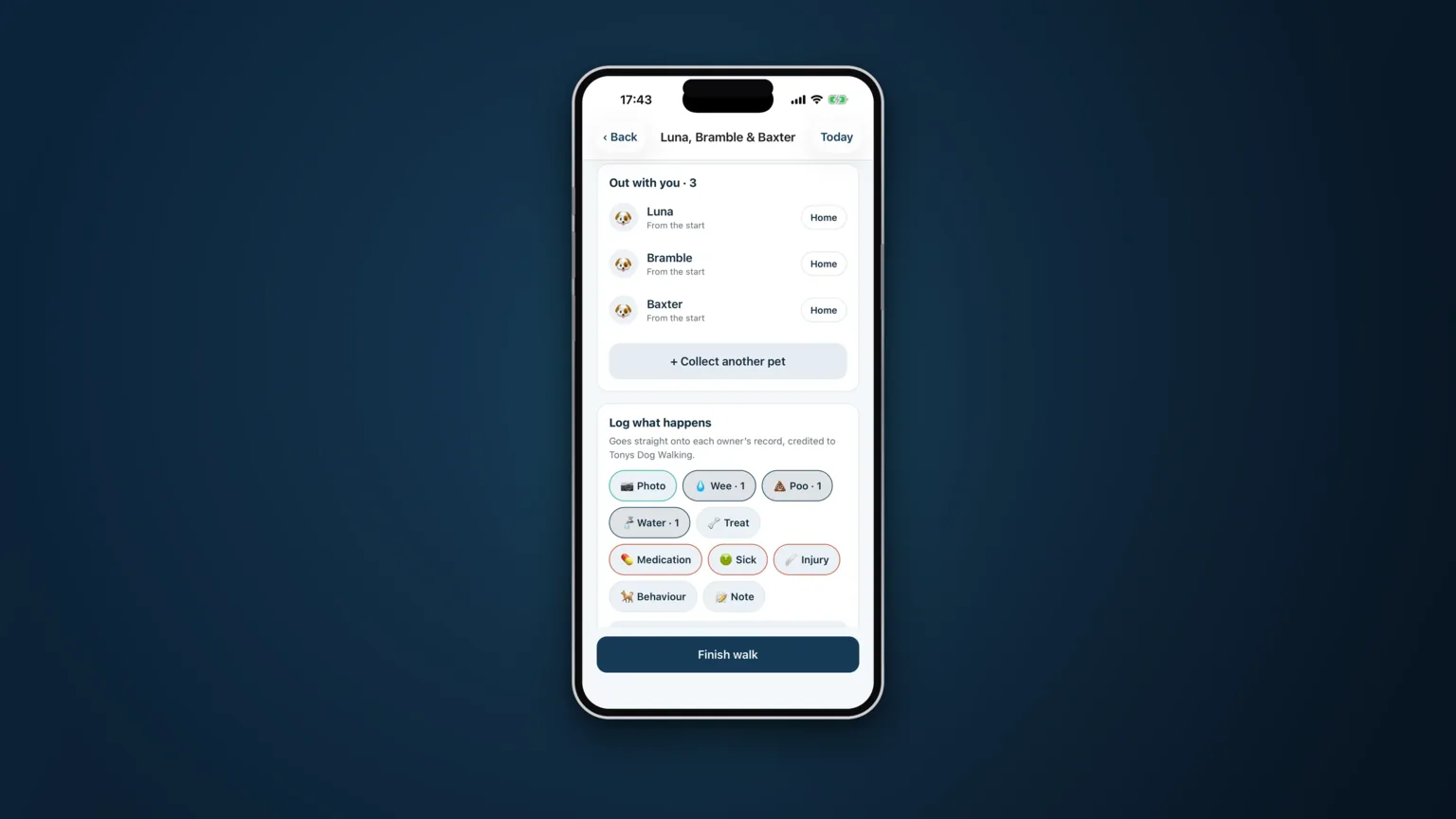
In CorePaw Pro the vet practice and phone and the emergency contact sit on the face of the client record rather than behind another tap. Injury and sickness are logged as events on the job with their own timestamps, photos attach to the job they came from, and the whole thing stays in that pet's history with the walker who was there recorded against it.
Related articles
Run the round, reassure the owner, get paid.
CorePaw Pro puts your schedule, clients, pet-care notes, GPS walks, owner reports and invoicing in one field-ready app — and keeps working when the signal disappears.
Full access for 30 days · No card · Unlimited clients and pets