How GPS walk records build client trust — and how they lose it
A route map reassures an owner that the walk was a walk. It also creates a number you are going to put on an invoice — which means a GPS record that is casually wrong is worse than no GPS at all.
By Tony Dalton · Updated
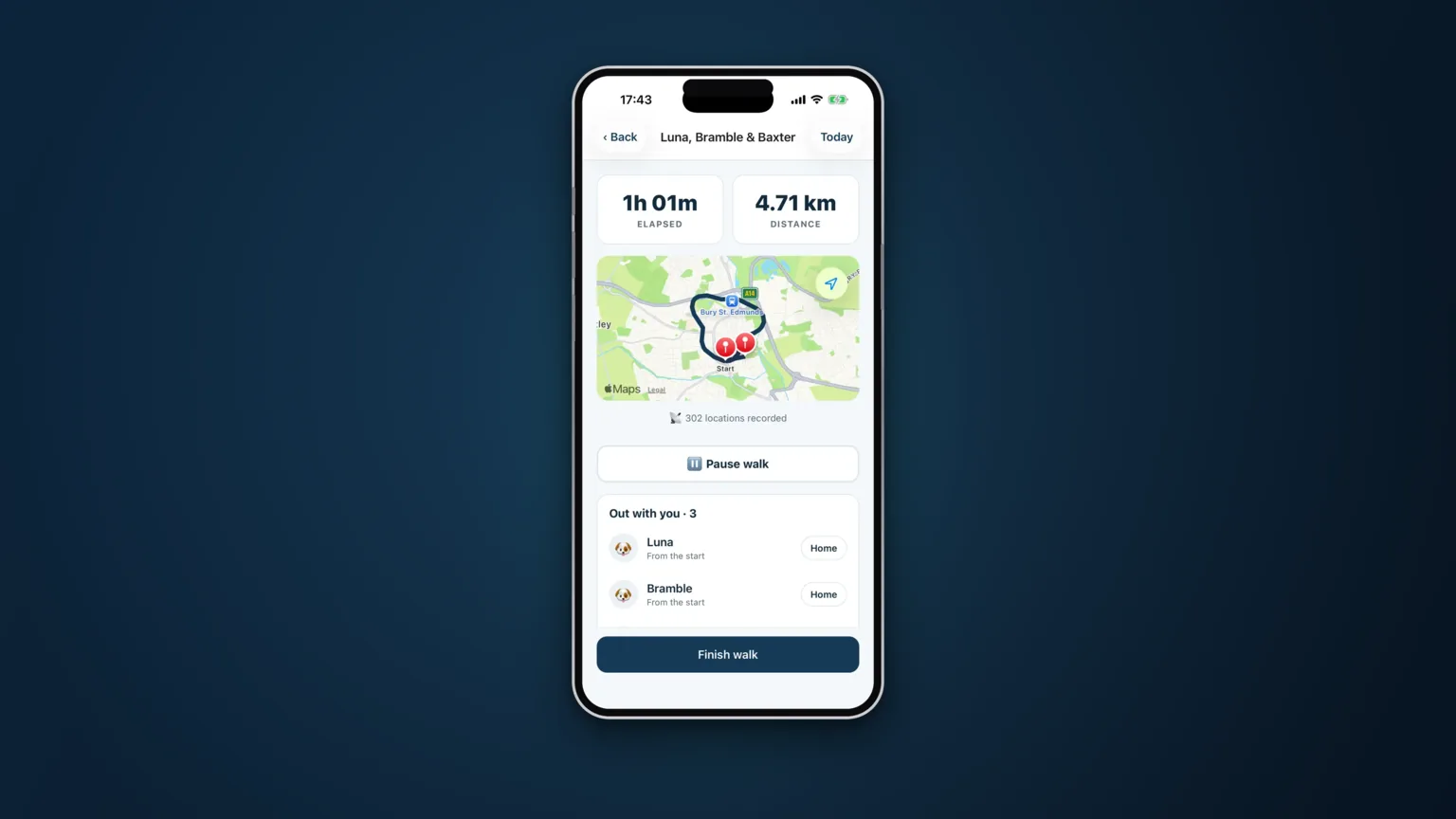
The first time a client gets a route map with their dog's walk report, something changes in the relationship. Not because they suspected you of anything, but because a whole category of low-level wondering stops. Did she actually go to the park? Was it really an hour? The map answers it without anyone having to ask.
That is the upside, and it is real. The part people think about less is that the moment you publish distance and duration, you have made a measurable claim — and you are going to bill against it.
Raw GPS is not accurate
A phone's location data is noisy. Under trees, between buildings, on a dull day, fixes drift. If software simply joins every reported point with a straight line and adds up the lengths, you get numbers that are wrong in a specific and embarrassing direction: too high.
Two failure modes matter for dog walking.
The spike
One bad fix places the phone half a kilometre away and back again within a few seconds. Joined naively, that single glitch adds a kilometre to the walk. The dog did not run a kilometre in six seconds, and if that number reaches an owner, everything else you have told them is now open to question.
The sparse route
Deep in a wood, the phone might get a handful of usable fixes across forty minutes. The honest response to that is to say the route is too sparse to measure. The dishonest response is to quote a confident distance derived from four points and a lot of imagination.
Pausing, and the drive nobody should bill for
Real rounds involve pauses. You stop to talk to an owner at the gate. You pause the walk and drive between two pickups. If paused time is counted as walked time, and worse, if the drive is measured as distance, then the record is not just inaccurate — it is inaccurate in your favour, on an invoice. That is the version of this that costs you a client.
Paused time should not be counted, and the paused stretch should not be measured at all.
Say what you do not know
The principle running through all of this is the same one that governs walk reports: state what was recorded, and be explicit where the record is thin. "GPS was poor on this route, so distance is not reported" is a sentence that builds trust. A confidently wrong 4.2 km does the opposite, and you will not know which walks were the wrong ones.
What owners should not get
There is a line worth holding. Live tracking of a walker's position by clients is a different product from a record of the walk, and it changes the job — it turns a professional doing their round into somebody being watched on a map. CorePaw Pro deliberately does not do it, and says so on the features page rather than leaving you to find out.
How CorePaw Pro records a walk
- Recording continues with the screen off and the phone in your pocket.
- Distance and duration are measured from the filtered route, not from a raw point list.
- Vague fixes and impossible-speed legs are excluded, so one bad fix cannot add a kilometre to an invoice.
- A route too sparse to judge says so, rather than quoting a confident wrong number.
- Paused time is not counted, and the paused stretch is not measured.
- Force-quit mid-walk and it offers to resume, with nothing lost.
Related articles
Run the round, reassure the owner, get paid.
CorePaw Pro puts your schedule, clients, pet-care notes, GPS walks, owner reports and invoicing in one field-ready app — and keeps working when the signal disappears.
Full access for 30 days · No card · Unlimited clients and pets