Managing group walks without losing per-dog records
Group walks are how a round becomes profitable. They are also where record-keeping quietly collapses: one outing, five dogs, and a single note that helps nobody. The fix is to treat the outing and the record as different things.
By Tony Dalton · Updated
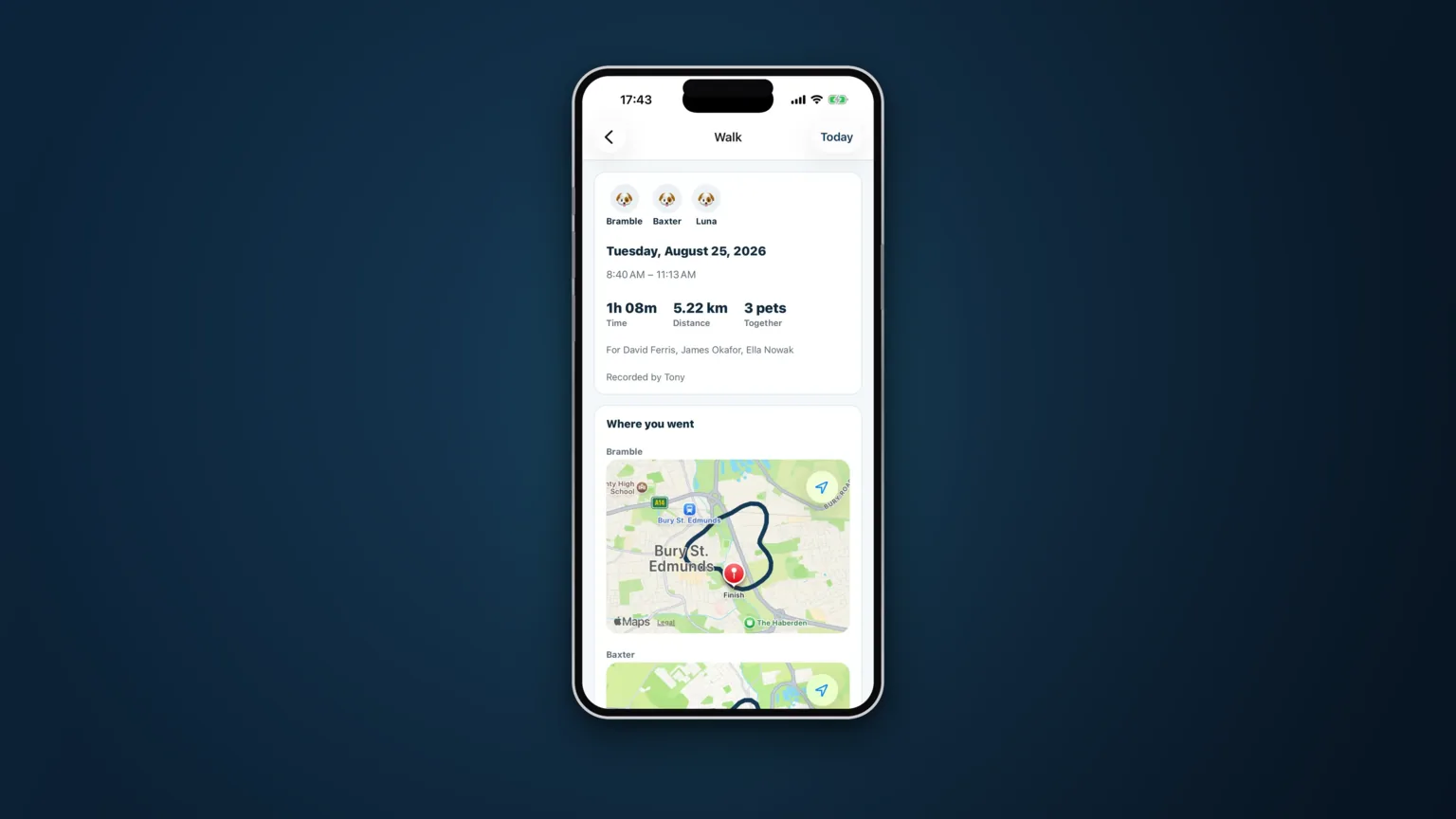
Group walking is the difference between a round that pays and a round that does not. Four dogs in an hour is four hours of billing in one hour of work, and for sociable dogs it is a better walk than going out alone.
The bookkeeping, though, is where it goes wrong. One walk happened, so one note gets written, and that note has to serve five different owners who each want to know about their own dog. What the owner gets is generic, and what you keep for yourself is worse: in six months there is no way to answer "how often has Bella actually been out with you?"
One outing, several records
The correct mental model is that the group walk is a logistical unit and the per-dog record is a commercial and care unit. They are not the same object and should not be stored as one.
Practically, this means that when the walk ends there should be one record per dog, each carrying:
- its own start and end time (dogs are collected and dropped at different doors);
- its own events — this dog toileted, that dog had water, the other had a treat;
- its own photos;
- its own billing line, at that client's price for that service;
- its own entry in that dog's history.
The route is shared. Almost nothing else is.
Log per dog, in the moment
The habit that makes this work is tapping against the dog rather than against the walk. "Poo" is useless on a group outing. "Poo — Baxter" is the thing that lets you tell an owner, two months later, that yes, this has been going on for a while and it might be worth mentioning to the vet.
It has to be fast, because you have three leads in one hand. If logging an event for a specific dog takes more than a tap or two, it will not happen on a wet Tuesday, and the record will be exactly as good as your memory that evening.
Composition is a safety decision, not a maths one
Who goes out together is not just about numbers. A group needs to be built from what you know about the individual animals — recall, sociability, who cannot be near bikes, who guards a ball, which two are fine separately and awful together. That knowledge belongs written down in the pet's record, not solely in the head of the person who happens to be walking today.
It matters most on the day you are not the one walking. A stand-in who can read "not with terriers; recall poor near the railway line" is in a completely different position from one who has been handed four leads and a postcode.
What to tell owners
Be straightforward that the dog goes out in a group — it should be in the service description and agreed at sign-up, not discovered from a photo. Beyond that, be careful about what you disclose. Other clients' dogs, and by extension other clients, are not yours to describe to a third party. There is a real privacy line here, and the safe side of it is to report on the dog whose owner is reading.
How CorePaw Pro handles it
You pick the dogs at the start of the walk and do the outing once. One walk becomes one record for each dog: its own events, its own report, its own place in that pet's history, and its own billable line on the invoice. Events are logged against the individual dog while you are out, in one tap.
See group walk management for the detail, and GPS walks and visits for how the recording itself works.
Related articles
Run the round, reassure the owner, get paid.
CorePaw Pro puts your schedule, clients, pet-care notes, GPS walks, owner reports and invoicing in one field-ready app — and keeps working when the signal disappears.
Full access for 30 days · No card · Unlimited clients and pets