How to move a dog-walking business beyond WhatsApp and spreadsheets
WhatsApp and a spreadsheet will run a round of six dogs. They start failing somewhere around twenty, and they fail quietly. Here is how to tell when you have crossed that line, and how to move without losing a fortnight to setting things up.
By Tony Dalton · Updated
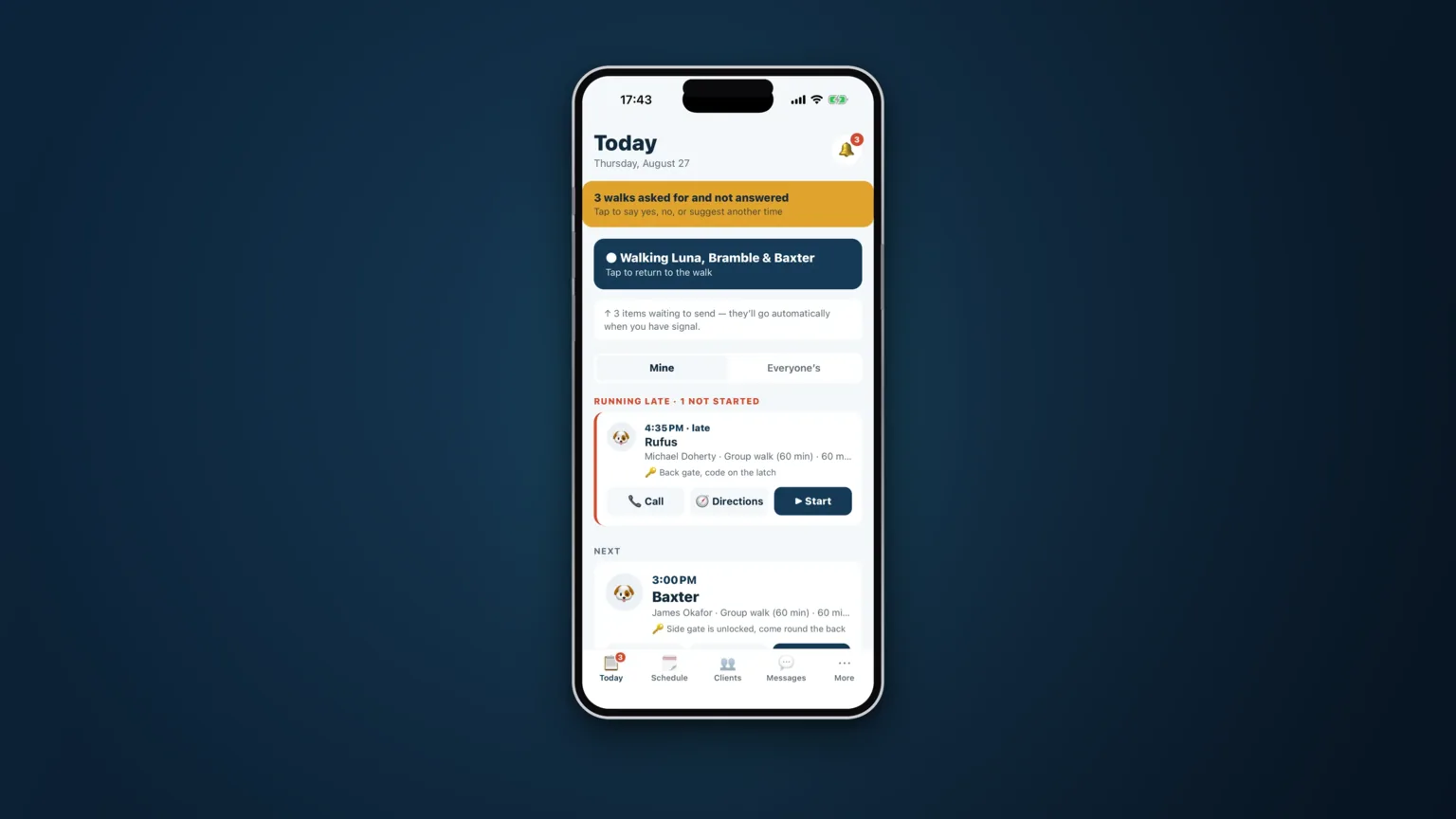
Almost nobody starts a dog-walking business with software. You start with a phone, a notes app and a couple of clients who text you on Sunday night. That is not a bad system. It is free, everybody already knows how to use it, and for six regular dogs it genuinely works.
The problem is that it does not fail loudly. There is no day where WhatsApp stops working. What happens instead is that the failures get distributed: one missed booking here, one walk you forgot to bill there, one owner who asks how their dog got on and gets a shorter answer than they were paying for.
The four signs you have outgrown it
1. You are the only backup
Everything a stand-in would need to cover your round — the side gate that sticks, the dog that cannot be let off near the railway, the vet's number, which client pays weekly — lives in your head and in a thread you would have to scroll to find. If you were ill tomorrow, nobody could run Tuesday without a forty-minute phone call.
2. Money is being lost to admin, not to bad clients
Month end takes an evening. You cross-reference the calendar against the messages, remember the two extra walks you fitted in on the Thursday it rained, and then decide it is not worth chasing the one you cannot prove. That is not a cash-flow problem. That is a record-keeping problem wearing a cash-flow costume.
3. Bookings arrive in four places
WhatsApp, Facebook Messenger, a text, and someone who told you at the door. Each of those is a separate place a booking can be missed, and none of them writes itself into your calendar.
4. Owners have started asking for more
Not because they distrust you — because they have seen a friend's dog walker send a route map and a photo, and now the two-word "all good!" reads as less than it did last year.
What to move first
The instinct is to move everything at once, over a weekend, and it is the wrong instinct. You will spend two days typing and end up with a half-populated system you do not trust. Move in this order instead, because each step pays for itself before the next one starts.
- The client and pet records. Names, phones, addresses, the gate instruction, the vet, the emergency contact, whether the dog goes off lead. This is the part that makes you replaceable — in the good sense.
- The recurring schedule. Not every one-off. Just the standing round: the dogs you walk on the same days every week. That is most of your income and most of your memory load.
- The record of what you did. Once the schedule is in one place, completed work becomes a list rather than a recollection.
- Invoicing. Last, because it is the step that only works properly once the three above are true. When the completed work is already recorded, month end stops being an evening of reconstruction.
What you should not lose in the move
Two things are worth protecting on the way out of WhatsApp.
The informality. Owners like being able to send you a message. Do not replace a conversation with a ticket system. What you want is the same conversation, kept with the business rather than with your personal number, and attached to the dog it is about.
Your phone number's privacy. If your clients have your personal mobile, every future employee inherits that problem, and so does every evening off. Moving the conversation into the business is the moment to fix that, and it is much harder to fix later.
A realistic first week
Set aside two hours, not two days. Put in the ten clients who make up most of your week — not all thirty. Run the following Monday through the new system while the old one is still there as a safety net. Add the rest as they come up naturally: a client you are walking on Wednesday gets entered on Wednesday.
By the end of a fortnight the system contains your actual working week, entered at the pace the week happens, and nothing was reconstructed from memory. That is the whole trick.
CorePaw Pro is built for exactly this transition — client and pet records first, then the schedule, then month-end invoicing off the back of work the app already knows you did. See how it fits together.
Related articles
Run the round, reassure the owner, get paid.
CorePaw Pro puts your schedule, clients, pet-care notes, GPS walks, owner reports and invoicing in one field-ready app — and keeps working when the signal disappears.
Full access for 30 days · No card · Unlimited clients and pets