How to set your dog-walking prices without guessing
Most walkers price by looking at what the person down the road charges. That tells you what the market will bear, not whether the work pays. Work it the other way round: start from your hours, your costs and the days you will actually be able to work.
By Tony Dalton · Updated
Ask a room full of dog walkers how they set their prices and most will describe the same method: find out what other walkers in the area charge, and land somewhere near the middle. It is not a stupid method — it stops you pricing yourself out of a village — but it answers the wrong question. It tells you what the market will bear. It does not tell you whether the round you are about to build will pay you a living.
Work from the day, not from the walk
The unit that matters is not the hour walk. It is the working day, and the working day contains a lot that nobody is paying you for directly:
- Driving between clients, which is the largest hidden cost in most rounds.
- Pickups and drop-offs, which are not walking time but are time.
- Writing up the walk and sending something to the owner.
- Admin: bookings, invoices, chasing, the meet and greet you did on a Sunday.
- Everything a vehicle costs — fuel, insurance, tyres, the eventual replacement.
Add those up honestly for a typical week and you will find that a "six-hour day" of walking is a nine-hour day of working. Your hourly rate is the money divided by the nine.
Then subtract the days you cannot work
This is where self-employed pricing usually goes wrong. An employed person is paid on holiday, when ill, and on bank holidays. You are not. If you price as though you will work 52 weeks, you have priced in a wage cut for every week you do not.
Decide, before you set a price, how many weeks you intend to take off, and accept that some weeks will be lost to illness and weather whether you intend it or not. Your rate has to cover the whole year out of the weeks you actually work.
Price the things that are genuinely different differently
A single 30-minute walk for a reactive dog who cannot go out with others is not the same product as a slot on a group walk. Solo work, puppy visits, medication visits, bank holidays and last-minute cover all cost you more — in time, in flexibility, or in the other work you had to turn down. It is normal and reasonable for them to cost the client more too.
The practical move is to keep a written service list rather than a single number in your head: 30-minute walk, hour walk, solo walk, drop-in visit, puppy visit, bank holiday rate. Once the list exists, quoting stops being a negotiation you improvise at the door.
Charge for cancellations, in writing, from day one
A cancellation an hour before is a slot nobody else can fill. A notice period and a fee are not aggressive; they are what makes a full round survivable. What makes them work is that the client agreed to them when they signed up, in writing, before there was anything to argue about. Introducing a cancellation policy after a bad month reads as a punishment. Having one from the start reads as a business.
Raise prices on a schedule, not on a crisis
The worst time to put prices up is the moment you realise you cannot pay a bill, because that is when it feels personal and comes out apologetic. Pick a month — many walkers use the start of the tax year or the start of the calendar year — and review then, every year, whether or not you feel you need to. A client who knows you review annually is not surprised. A client who has had the same price for four years is.
There is more on how to run that conversation in how to tell clients about a price rise.
What the numbers should tell you
When you have done this properly you will have three figures you can defend: what a day of your work costs to produce, what you need it to earn, and what each service on your list has to be priced at to get there. That is a very different conversation from "the woman in the next village charges £15."
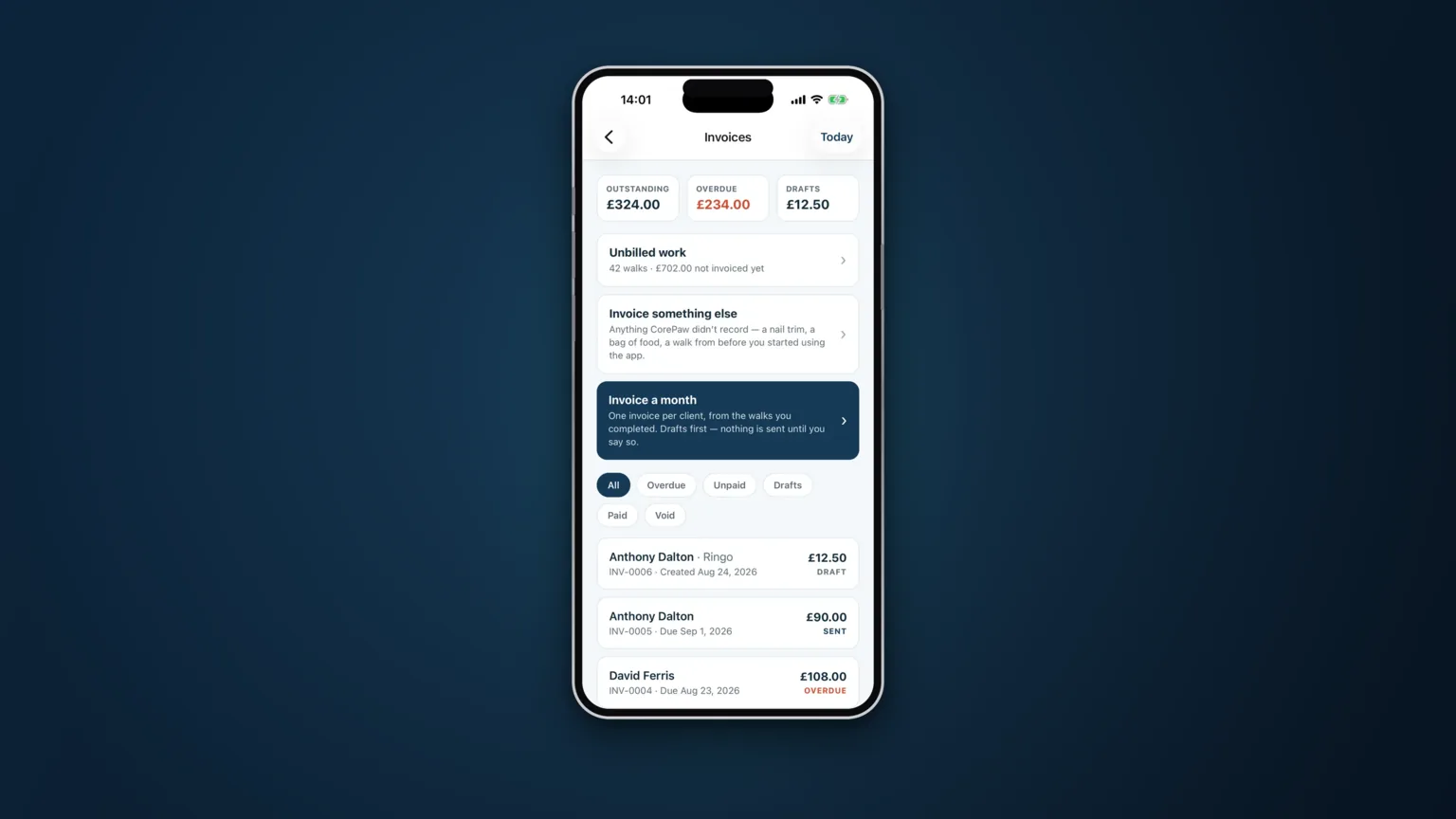
In CorePaw Pro your service list and prices are set once and then used everywhere — bookings are priced from them, cancellation fees follow your own notice period, and completed work carries its price straight through to the invoice. Setting up your services and prices walks through it.
Related articles
Run the round, reassure the owner, get paid.
CorePaw Pro puts your schedule, clients, pet-care notes, GPS walks, owner reports and invoicing in one field-ready app — and keeps working when the signal disappears.
Full access for 30 days · No card · Unlimited clients and pets