Solo dog walker versus team scheduling: what actually changes
Going from one walker to two is not "the same diary, twice". Three specific things change — assignment, visibility and attribution — and the businesses that struggle are usually the ones that only noticed the first.
By Tony Dalton · Updated
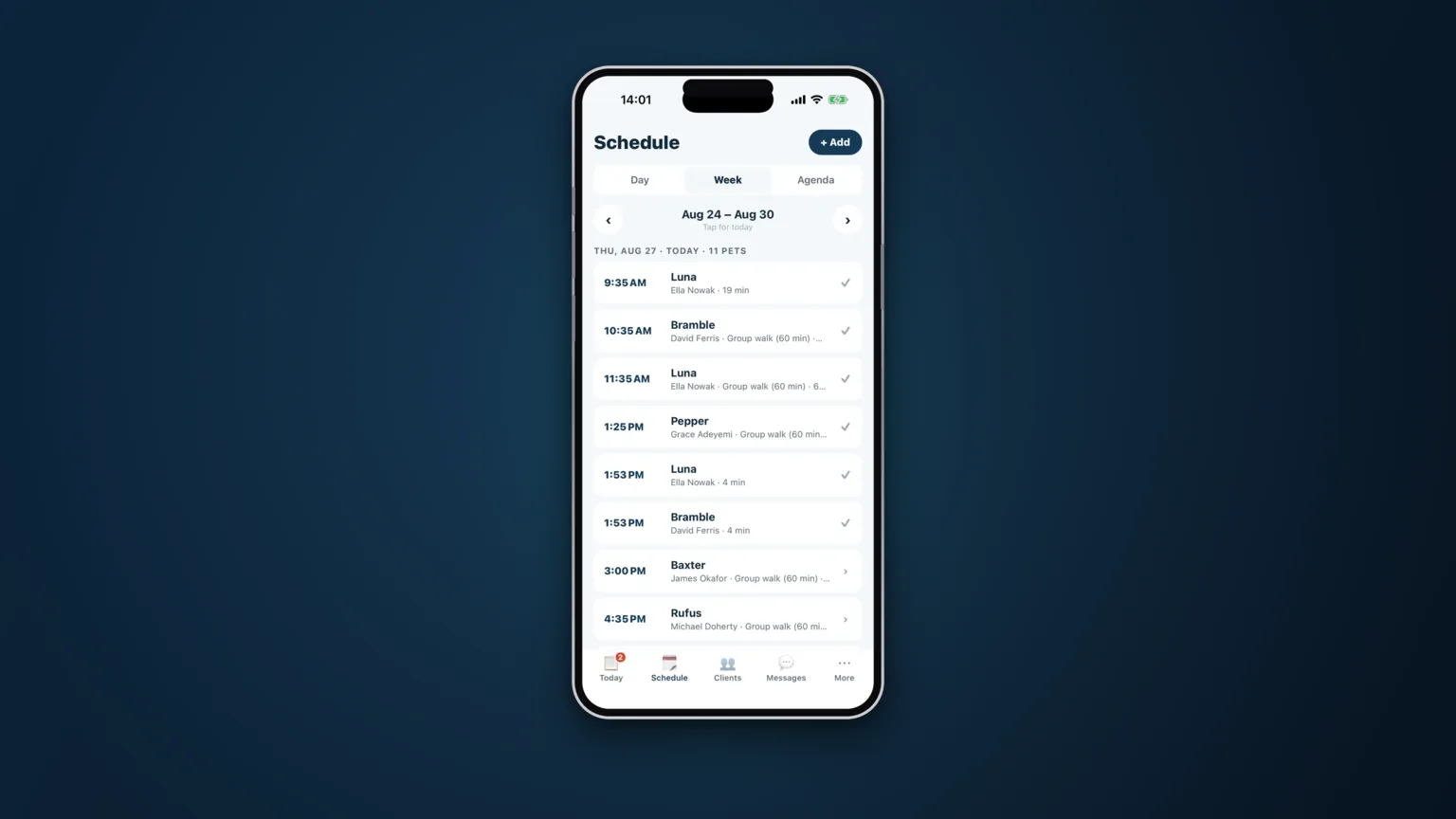
A solo walker's diary is a list of jobs in time order. It works because there is exactly one person who could possibly be doing any of them, and that person is reading the list.
The moment there are two walkers, that assumption breaks, and it breaks in three places at once.
1. Every job needs an owner
With one walker, "who is doing this?" is not a question. With two, it is a question that has to be answered for every single job, every day, and answered somewhere both people can see. The failure mode is not double-booking — it is the quiet gap, where each person assumed the other had Wednesday's eleven o'clock.
Assignment also has to survive change. When somebody is ill, reassigning their day should be a change to the schedule that both people see, not a phone call whose outcome exists only in two heads.
2. Not everyone should see everything
This is the part solo walkers do not anticipate, and it is the one with consequences.
Your client list is the business. A part-time walker covering six jobs a week does not need the addresses, phone numbers and access instructions of your entire book — and your clients did not agree to their details being visible to everyone you hire.
The right default is that a walker sees the clients they have work for, and not the rest. That is not distrust; it is the same reasoning that stops a shop assistant having the safe code. It also makes taking on help far less daunting, because hiring someone stops being an all-or-nothing disclosure.
Money is its own category. Whether an employee can see invoices, totals and who owes what should be a separate decision from whether they can see the schedule.
3. Records have to say who did the job
Solo, attribution is implicit. With a team, "the walk happened" is no longer enough information — for the owner, who wants to know who has their key and their dog, and for you, when a question comes up about last Tuesday.
Every completed job should record who actually did it, on the owner's report and in your own history. This is also the foundation of any pay calculation you do later, and of any conversation about quality.
What should not change
Two things are worth preserving from the solo setup.
Clients still belong to the business, not the walker. The conversation, the records and the history stay with you when a walker leaves. A round where each walker has their own relationship in their own phone is a round that can walk out of the door.
Simplicity for the person doing the walking. An employee's day should look like a solo walker's day: their jobs, in order, with what they need to do them. All the assignment machinery is your problem, not theirs.
How CorePaw Pro handles both
Everything hangs off the business, so a solo walker is a business of one — with one walker the team screen says "just you" and the assignment picker does not appear at all. Add people and any booking can be assigned to any walker. Full-access partners share everything, which is the couple running a round together; restricted employees get their own login with only what you allow, and clients, schedule, editing and money are each separately grantable. Per-pet visibility means an employee sees the clients they have a booking for and not the rest of your book — enforced in the database, not by hiding buttons. Every job records who did it.
Related articles
Run the round, reassure the owner, get paid.
CorePaw Pro puts your schedule, clients, pet-care notes, GPS walks, owner reports and invoicing in one field-ready app — and keeps working when the signal disappears.
Full access for 30 days · No card · Unlimited clients and pets